Showing posts with label math. Show all posts

Sunday, September 16, 2012

Homeschool Happens

Today is Sunday. It is not a "school day" and we don't have our usual "school time". No math, or science, or literature studies.

But really?

Brother-Bug is helping Papa-Bug brew a beer - a nice, dark stout for the colder days of fall and winter. Sister-Bug is helping too of course, but she is more of a spectator.

In the past hour or two we have covered volume measurements: how many quarts in a gallon? How can we measure that? How many gallons in a carboy? (5-7, depending on the carboy.) We watched a thermometer carefully until our heating water reached 167 degrees. Also, along with this math is a fair bit of cooking process - pouring carefully, awareness of hot stoves, etc.

As it turns out, there are 4 quarts in a gallon, and an accurate measuring device is a better choice than a bottle that looks close.

What about learning a little science on a Sunday? Right now Papa-Bug is explaining how the barley in the beer will convert its starch into sugar to make the sugars to feed yeast. We have also covered energy and thermodynamics in heating water, what is specific gravity and how to test for it using our brewing/scientific equipment, and now we are covering the conversion of yeast to alcohol in more depth.

We aren't sitting and "learning", but that doesn't prevent plenty of on the fly lessons that present themselves. I was just interrupted to hear the "first law of "propane dye-hammocks" - which he got right (thermodynamics- you can't create energy and you can't destroy energy).

I paused writing to get a batch of bread going, and now we have moved on to the intriguing question: "If we had 100,000 jelly beans and had to eat them in one year, how many jelly beans would we have to eat every day?" This was followed by the more philosophical question: "Can you have too many jelly beans?"

We have (almost) daily school time and I think that half-hour or so is important. We learn routine, sitting and focusing even if we don't always want to, and other valuable skills. The beauty of being out and about in the world with homeschooling is just that - seeing the entire world as a learning opportunity. You never know what lesson is coming your way or what question is about to be asked. So I don't worry at all when our structured school plans go askew, because often a bigger and better lesson is just about to fall in our laps and we can learn all about propane dye-hammocks.

Wednesday, August 29, 2012

First-Grade Launched!

Origami day! World culture, art, geometry, fun!
If Brother-Bug were in school he would be starting Kindergarten next week. But he's days from six and we've been doing Kindergarten level work for 2 years now. I asked him what he wanted - more Kindergarten or to move on to First Grade. He decided to go forth and First Grade it up.

I love our plan to teach subjects in month long blocks, but we are loosening that structure for the moment, to be more flexible with the beginning of our new baby's life. Instead, here are some of the up and coming adventures in our first grade plan:

1) Have a baby. Incredibly educational, and a good reason to put out usual plans on hold. Baby-Bug is coming in November so much of the autumn will be spent getting ready for that addition. It's been really sweet to see Brother-Bug get all excited and to help explain things to Sister-Bug. He remembers a lot from waiting for her and he's doing a great job of helping us all get ready for a new baby.

2) Daily school time. We are focusing on 10-40 minutes most week days on "school time" when we sit at the table and focus on an educational project of some sort. I believe that this daily practice is the lesson in itself.

3) Hand writing. This is how we start off our school time. I print out a d'Nealian worksheet for each day and he loves it. A longer post (rant) about hand writing will be posted eventually.

Working with patterns. Basic math. 
4) Lots of math exploration. I've mentioned my Dad's wife in previous posts - she was a teacher in an amazing school in North Carolina for 30 years. She shared her manipulative-based exploratory math curriculum with me. What a blessing! I'll write more about that later also.

5) Science Club! I gathered several families from our homeschool group and we are meeting once a week for our K-2nd graders to do an experiment together. Exciting! This will combine learning, socializing, and parental-networking all it two hours a week. It's a homeschool win!

6) Papa-Bug was a political-science major, and loves an election. We will be using the Presidential Election as a great opportunity to learn a little about how government works. Already Brother-Bug is fascinated by the electoral maps at 583.

7) Ballet, just like last year. And also working on more formal piano lessons.

It looks like a lot, all written out like that, but in reality we spend 1-2 hours a day engaged in "school". The rest of the time we are playing, reading, questioning, and exploring. And who knows what will change as we move through this third-trimester. Of course lots of other adventures will find us - hikes, explores, canning peaches (today!), reading aloud, story telling, drawing... We would have to lock ourselves in an empty room to prevent learning from happening!

===

I am keeping Sister-Bug involved also. Each day for school time she gets to select a coloring sheet and color it with  her special "school crayons" while I work with Brother-Bug. Sometimes we mix it up with beads to string, or other 2-year old appropriate activities. School time is her favorite time of day and I'm glad she is already getting used to the daily habit of sitting down together for some focused learning time.

Sea shell coloring. Special crayons. She's happy. 

Tuesday, August 21, 2012

Sushi Math

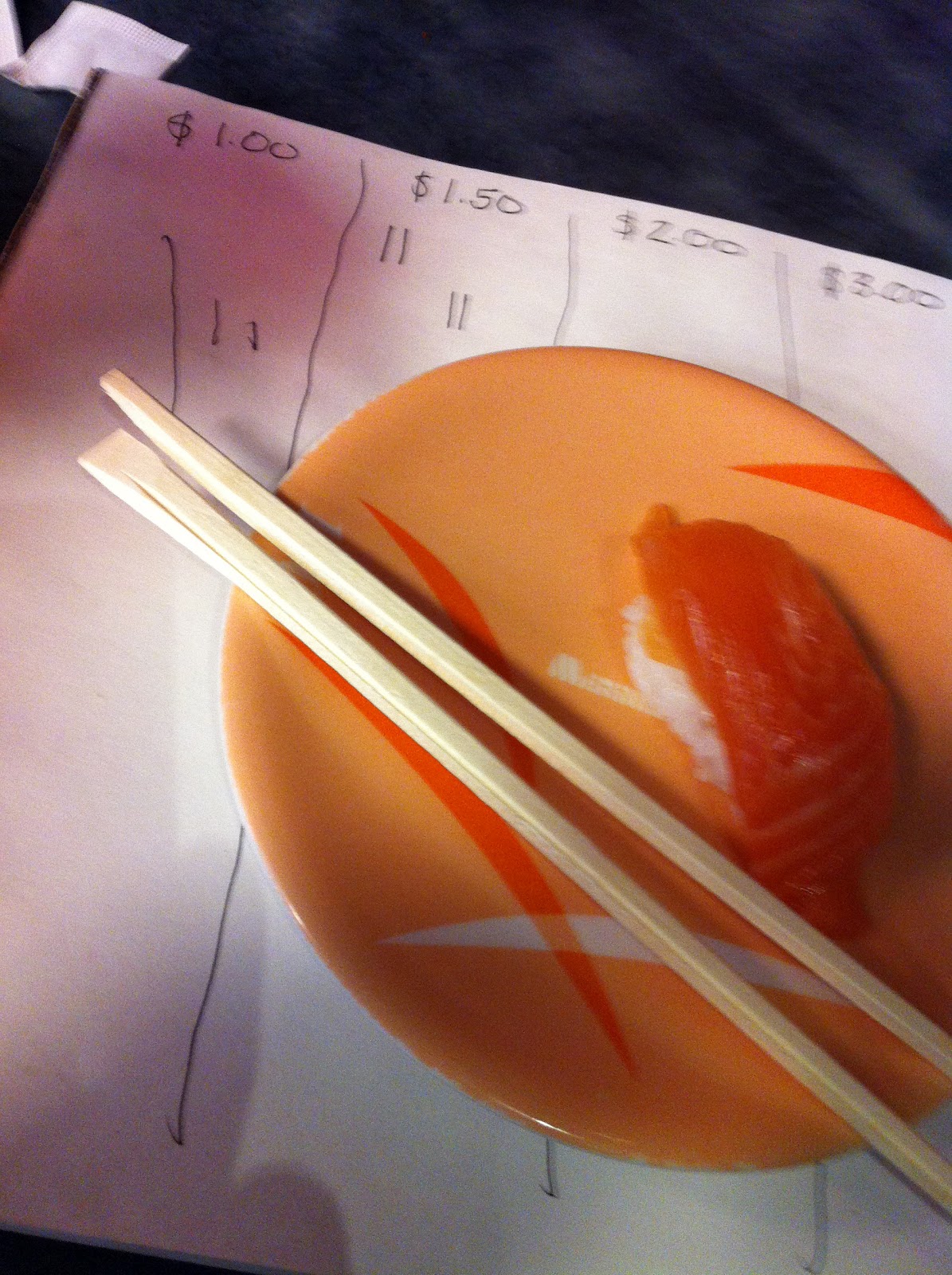
Brother-Bug's all time favorite restaurant is SushiLand - one of those sushi places where we sit next to a conveyor belt and sushi rolls past us in limitless quantities. He tries it all, enjoying some things that I just can't stomach. At our last trip to the sushi restaurant, I realized we had an excellent math game right in front of us.

There are so many possibilities. The plates are 1.00, 1.50, 2.00, and 3.00 each. You pick your plates and the waiter adds up your total at the end of your gorging. On this trip, we kept it simple, just playing with some of the many numbers we encountered.

What to eat next? Tuna? Salmon? Octopus?


I kept my plates in one pile, he kept his in another pile. We estimated who was eating the most by looking at the two piles. At first we tried to keep track of how many of each plate, making hash-marks on our paper...but we got to excited about eating sushi to keep up with that.

It was just too good to track while we were eating...

At the end of our feast, we counted up. How many of each plate? How can we figure out the cost of that stack? Who ate the most? (He did - he out ate me by one plate.) About how much money did we spend? Which plate - 1.00, 2.00 - did we eat most of? Least?

Brother-Bug starts counting. I ate 9 plates. He ate 10. 


It was an awesome math game.

There are so many places it could expand as well. Multiplication, division, quantity of individual rolls...  Mental math as we add up the total... I could give him $15 and he could figure out some budgeting... And going the other way, we kept Sister-Bug involved by having her do some basic counting practice - how many rolls are on this plate? Everyone was really happy, full of sushi, and enjoying finding a new math game out in the world.

Bonus! Sister-Bug works on her fine-motor skills with her chopsticks....

What other things could we do with Sushi Math? I guess we will have to go back...


Tuesday, November 15, 2011

October Kindergarten Review: Weather & Seasons

With the weather changes and fall leaves that blow about, October seemed like the perfect month to think about weather and the change of the seasons.

We got a bunch of library book, pulled out some of the science books, and jumped right in.

Brother-Bug was already good on the seasonal differences, knows what season we all have our birthdays in, and some of the things that are traditionally done in each season, so much of the focus was on weather.

The first thing we did was make a calendar of October and start charting the weather each day. We marked if it was sunny, rainy, or cloudy, and if we thought is wag hot or cold. This was excellent practice for handwriting skills and observation (especially the observation skills for my book-bound little boy who would rather read than do anything else). On November first we counted up how many of each kind of day we had had - how many hot, how many sunny, etc. and made a list. We had a little discussion of what there was the most of, the least of, and how (looking at our list) we would describe the October weather. Was it consistent with our memories?

The detailing of the day's weather.

We did two awesome hands on science projects to learn about pressure in the atmosphere. The first was making clouds in a bottle! Papa-Bug found the instructions on this site and what fun we had. It was great for us to see exactly how pressure changes the cloud state. I think I learned as much in the project as Brother-Bug did.

Changing the pressure, creating a  cloud.
Once we knew about pressure, we made our own barometer, using these instructions. We watched the pressure everyday - here again I think it was just as fun and edifying for the grown-ups. We've decided not to disassemble the barometer because it's so fun to check everyday, as well as being useful for biking and hiking and planing other outdoor activities. Brother-Bug wrote a short report about what a barometer is and how it works. The way we write reports right now is that I ask leading questions and write down his answers, helping him find the answer if he gets confused.

We did seasonal activities, like a visit to the pumpkin patch, and hunting mushrooms - with discussion about what things are specific to each season, what comes ripe and what is happening in the garden, and similar.


Papa-Bug put a Weather App on his iPhone that Brother-Bug could easily navigate. Then they put location pins in familiar places - where friends live, where favorite books are located (James and the Giant Peach, for example, is in New York City). Bother-Bug would take the phone and Papa-Bug would quiz him to find out what the weather was in... North Carolina? Is it hotter or colder there than in NYC? What will the weather be like in three days where your Aunt lives? And so on. We learned all kinds of geography (a great carry over from last month's study of maps), comparisons, research, and sorting skills - and it was on the iPhone... which always makes it a special project.

We started a simple art project, making a tree showing all four seasons to tie into our conversations. I set Brother-Bug the task of using the hole pinch to meek snowflakes. He was having such fun with that job that I changed my plan mid-stream to let him do a lot more punching. He punched small green leaves and pink flowers for spring, and cherries for summer while I glued things. Then we listed out some on the things we notice or do in each season, leaving plenty of room. Finally (to keep enjoying the hole punch and do some math) we sent out a text to many friends and relations, asking their favorite season. When they responded, he found the season and joke punched it to tally. Of course we followed up with a review of the results - which season has the most/least kind of questions. .

Those were the high points of our October. On to November and learning about emergencies - first responders, what to do, who to call, buying a fire extinguisher, and so on.

===

Usually I get these reviews out in the first week of a month. With the Occupation work our family is doing, regular life, my writing projects, and preparing for the holidays, blogging has taken a bit of a back burner. Thanks for your patience. After Christmas we will return to our regularly scheduled blog adventures.

Thursday, May 26, 2011

Math Beans

Here in homeschooling land we look for different ways to play and learn, so as to engage as many part of our brains as possible. For math, we really like the skill building over at IXL, as well as cooking, helping with shopping, general counting, and other similar tasks. This week I also made a Math Bean Game, with the help of a few beans and 2 egg cartons. It is basic, almost free, and nicely hands-on for a little person.


(You can click on the picture to get a clearer shot of our game.)

With a marker, write the numbers 1-12 in the first egg carton. Then 1-6 on each side of the second egg carton. In the second carton put the correct number of beans in each side, using two different kinds of beans (we used pintos and garbanzos, but you could also use 2 colors of beads, or marbles, or what ever). That's it. Now play! 
One way to play: take the beans from a #2 slot and put it in the #4 slot. How many of the other kind of bean do you need to make 4? 

Obviously you can do whatever numbers you want to do. You can add, subtract, work forward, work backward... all kinds of math play is possible with this practically free game!